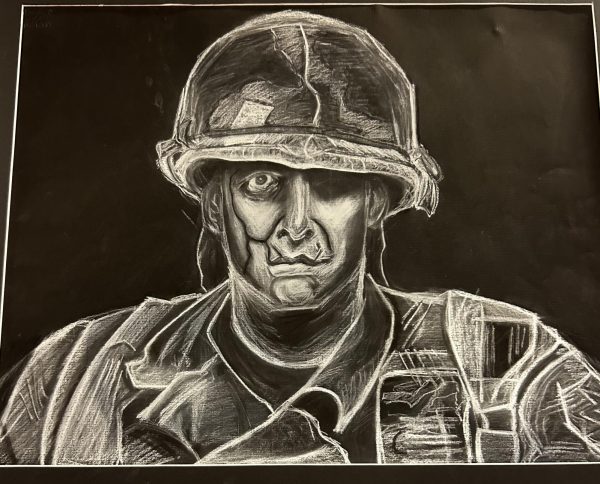
 From scribbling images of your family with crayons onto construction paper to graphite drawings of your dog in art class, it is evident that life experiences shape the artwork one produces- and for many it is simple. When prompted in class, they draw something explicitly from their life, creating a personal narrative on paper. Things are exactly what they are, and they affect you just as you would imagine. The dog is just a dog, and the house is just the house you live in. Yet, for many artists, it is much more complex, and the art they make does not just show their own life experiences but the world outside theirs. This outside view is important as it creates artwork that not only makes the artist do introspection and learn about a life outside their own, but it also makes the viewer think. CMW artist, Maggie Phelan, demonstrates the power of incorporating experiences outside your own into your artwork.
Her artwork consists of varying themes, but one theme that is weaved throughout her portfolio is the military. While Maggie has no distinct personal experience involving the military, as she herself has never served, her grandfather did. He was a huge part of the creation of her overall motif. Maggie shares, “what interested me in the first place was when I went to different civil war battlefields with my grandfather and father – I visualized the soldiers on the literal battlefields, and it soon translated to my art.”
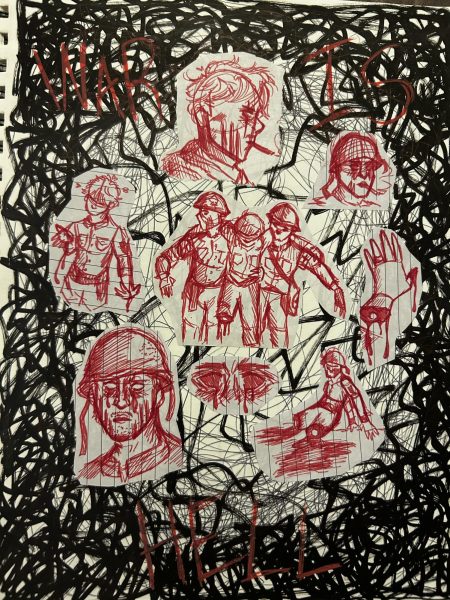
This has inspired her artwork and is why you can find military battles and soldiers throughout her portfolio. The experience of the pain, grief, terror, and mourning of someone who has served are not her own, but she is able to masterfully illustrate it, presenting history on paper. Although Maggie reiterates that she could never fully represent the terrors of war that soldiers go through, I believe she comes relatively close. Maggie’s art piece, “War is Hell”, artfully executes the dark side of war that victory shields. Her drawing depicts amputated soldiers on a chaotic battlefield represented by her use of dark abstract lines. I was drawn to this piece because it is messy and it is bold. While relatively simple, it evokes exactly what’s she intends, terror and pain.
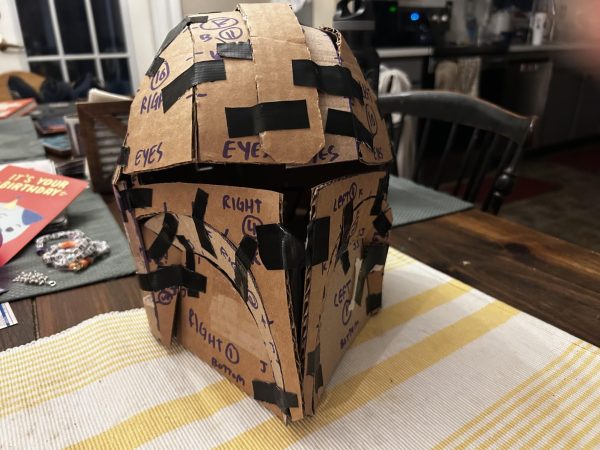
History is something Maggie deeply values. Art pieces of the Civil War, World War 2 and the Vietnam War are topics that she is not a stranger to. Even so, sometimes, Maggie makes art that is not made to evoke a certain feeling but rather just to fight boredom. Art made purely for fun. This is seen in her series of wearable helmet sculptures. She uses cardboard and glue to shape accurate helmets in the Star Wars series, The Mandalorian. While not as elaborate or complex as her realistic portraits, her helmets show that motifs can transcend one medium. Plus, if I’m honest, they are just really cool to look at and physically hold. She says, “creating helmets is something new for me, and I love it. What inspired me was the fact that I haven’t done 3-D art in a long time and I was getting tired of drawing everything. Also, helmets are really cool and are a piece of art you can actually wear, which is pretty epic.”
Fanart is another type of art that Maggie holds dear. No one wants to admit fanart is so intertwined within the art world. “Saturn Devouring His Son” by Francisco Goya is merely fanart of Roman mythology and so is the “Birth of Venus” by Sandro Botticelli. People love to forget that fanart is everywhere and is not only tied to fandom. Maggie, who is a huge fan of western movies, particularly “Tombstone”, creates art pieces of her favorite characters and scenes. To those who have never seen the movie, her artwork is beautiful illustrations of men going through the hardships of the time such as tuberculosis. Her artwork shows that you don’t need to be a part of a fandom or see the inspiration to understand the themes and feel the emotions of an art piece.
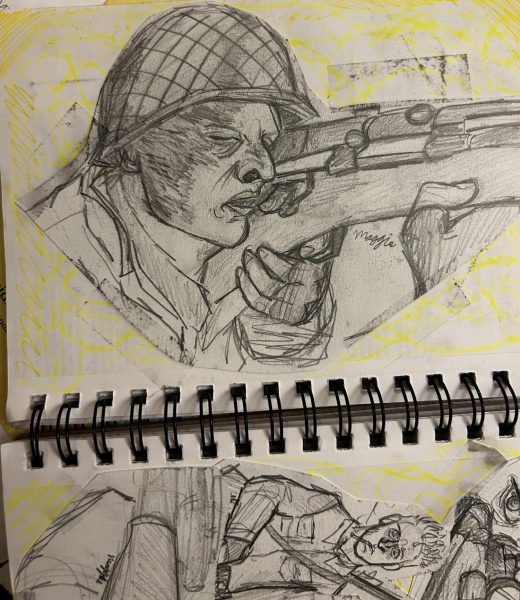
Something most artists hold dear is their sketchbook. Maggie is no different. Her sketchbook is filled with captivating pieces and is where most of her art can be found. Weirdly enough, each sketch feels like a complete piece, with both line art and color that finishes each sketch. Even basic graphite sketches are finished off with bright backgrounds that set her art apart from the rest. Maggie uses her sketchbook to create for herself, not for the eyes of others. To both fight boredom and to see her imagination on paper, she can be seen drawing away in her large spiralbound book. While she is not tied to a specific medium in her art, she explains, “I kind of have a set few mediums that I like working with. I’m willing to try new things always, but some mediums, like colored pencils, are not for me.”
A National Art Honor Society (NAHS) membership is a honor presented to artists who uphold important values of community and leadership. Maggie Phelan worked to obtain this membership through hours of volunteering. She was a part of some of the most well-known art projects at CMW, such as National Art Honor Society’s collaboration with Stage Wright to create artwork for an auction that raised hundreds for NAHS. Maggie is not only an artist; she is also a key member of the science chapter of NHS at CMW and does Envirothon. Maggie is a multifaceted student who is dedicated to her community and to her academic success. Working alongside her in NAHS and in science courses has been nothing but a joy and I am excited to see what she does in her senior year.
.
Maggie did not become a talented artist by staring at a blank sheet of paper. She became an artist by putting that first mark. Most artists agree, the first mark is the hardest part, as no one wants to ruin the pristine paper. Artist block can hold many beginner artists back, as they may feel they are not good enough and overthink their process. Maggie advises, “to beginner artists, I say draw and make what you’re interested in. When I didn’t care about starting with anatomy or composition or anything like that, I did my best work because it came naturally to me, and the ‘basics’ to art came along the way.”